Recent research from BigHand found that 35% of mid-sized firms lack visibility into associates' skills and capabilities, and 31% lack visibility into availability. These are significant gaps that impact daily operations and long-term growth.
What work allocation looks like day-to-day
A new matter comes in and needs quick staffing. The tracker is out of date. The usual go-to associate is tied up. The work calls for skills beyond the partner’s usual circle.
What happens next is a string of checks, messages, and guesswork. Partners rely on memory and outdated details to make it work. Decisions get revisited, and time meant for clients gets lost to coordination.
Jenny-Anne Flores, Director of Practice Administration at Liebert Cassidy Whitmore, captured the day-to-day in a session on making legal tech decisions that drive sustainable profit:
“Partners generating work, sending an email, senior counsel generating work, even our associates generating work. It's just flying emails all around. They were making assignments based largely on billable hours [...] That information was decentralized. Our partners couldn't keep everybody's professional development goals and dreams in their head.”
The cost of working around poor visibility
This cost rarely shows up on a balance sheet, yet partners feel it keenly. Time is lost chasing down availability, redeploying associates, and shifting work when pressure builds - creating unnecessary friction that everyone would rather avoid.
There’s a bigger, structural effect. Without visibility, it’s tough to standardize allocation. Work gets done, but not always by the right person at the right time. For mid-sized firms, where client relationships set you apart, that inconsistency matters.
Limited information also concentrates risk. When information is limited, work flows to the people known to deliver. That's sound in the short term, but over time certain associates become consistently overloaded while others stay underused. Access to good work narrows, and so does development. For partners, the pool of people they can confidently staff against shrinks, which increases dependency on fewer individuals. The firm’s overall resilience takes a hit, and opportunities for newer team members are stifled.
What changes when visibility improves
Firms that improve allocation are finding ways to give partners a clear view of who has capacity and where skills sit, without needing to cross-check several different places.
That changes three things for partners in particular:
- Less second-guessing. Less time spent validating decisions after the fact or undoing them when conflicts surface.
- More even workloads. Associates have more equitable access to career-building work, and the benefits of professional development are shared across the team.
- More partner time back. Greater availability for client work, business development, and supervision.
Clients notice the difference: work is handled consistently and by the right person.
Again, I’ll refer back to a quote from Jenny-Anne Flores at LCW, who describes what’s changed since they implemented BigHand Resource Management to centralize availability and suitability information:
“The biggest change is the readiness of data, which we were lacking in the past. But now we can see how many requests are coming in on a weekly/monthly basis, how fast we are able to get an attorney assigned to work, and it lives alongside info with how much an attorney is billing against what project they’ll be doing. It’s data we’ve never had marshaled together that neatly in a way so visible.”
A realistic path forward
Partner judgment remains central. What changes is the information behind it: availability, workload, and capability, all visible when decisions need to be made. This is a practical fix that pays off in less rework and more consistent allocation.
As AI changes how legal work is delivered, this foundation becomes even more important. Firms need clarity on how work is structured, how skills are used, and where technology fits with people. Without visibility into these areas, bringing in AI in a way that supports client delivery and lawyer development gets much harder.
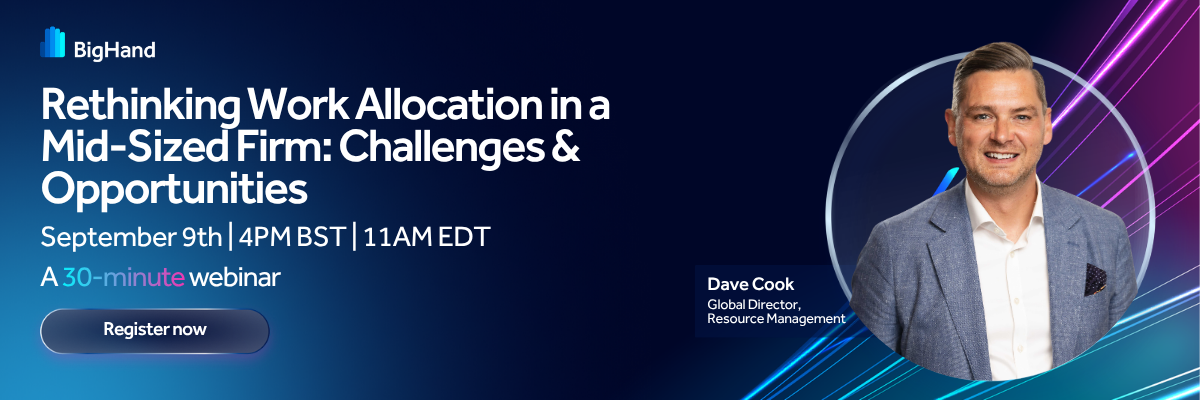
Don’t miss our upcoming 30-minute webinar with Dave Cook, Global Director of Resource Management. He’ll be exploring practical ways mid-sized law firms can move from scattered spreadsheets to a transparent, unified view of work allocation and team capabilities. Sign up now.