Many are already using or piloting tools like Harvey and Legora, and the rest know the clock is ticking as client expectations and delivery models shift around them.
While leadership teams try to make sense of this wave of change (How do we price AI-enabled work? How will clients react? What will this do to our culture? How do we stay ahead of the curve?), one question consistently rises to the top:
‘What does all this mean for our people?’
And this is where legal resource management and strategic work allocation play a much bigger role than many realise.
In my position, I'm fortunate to interact with many law firm leaders across the C-Suite and Partnership. When you ask about their biggest challenges, AI will almost always be wrapped up in the answer. A second recurring theme, however, shines through. So many of the question marks they’re working through in the boardroom seemingly focus on people.
Age-old workforce strategy challenges meet brand new, fast-evolving ones.
The Shifting Landscape of Legal Talent Management
Before AI really took off in legal, there was already a changing landscape. Yes - change accelerated by the global pandemic. Well-documented generational shifts in career expectations, increased interest in work-life balance, and preferences for flexible and hybrid working models have all led to firms having to adapt how they operate. In many cases, it seems this has led to a productivity challenge.
It’s not surprising that legal professionals today might question the traditional law firm experience of doing your time and working all hours - no questions asked - until eventually you make Partner. They’re operating in an age where making multiple career moves, including directional shifts, is normal and available to them. This is combined with a pre-AI explosion, period of high demand and significant power, both in the lateral market and at the entry level. Firms have been fighting over the best talent and prepared to pay high salaries and make substantial career promises.
This has created the expectation for fee-earners that they can have work-life balance, flexibility in where and how they work, and influence over what work they do and don’t take on. Whether or not you think that’s right, it’s clear that for law firms, these things impact the return-on-investment for their key commodity, their lawyers. Salaries have risen, yet many firms are feeling a squeeze on productivity, and at the same time as having to cope with intensifying client demand for transparency and cost-efficiency.
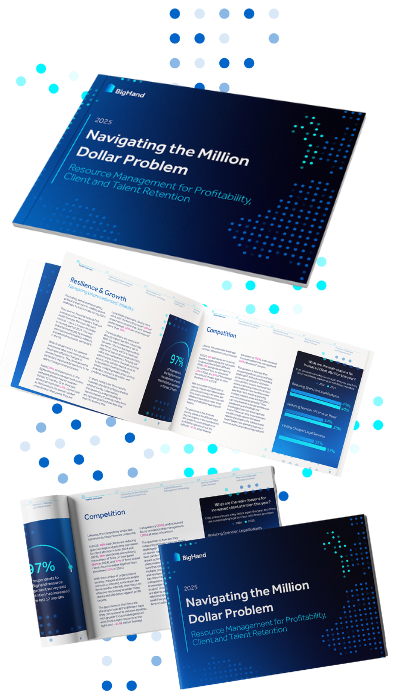
Our recent report, Navigating the Million Dollar Problem, highlights just how acute this pressure has become. While 86% of law firms stated that client demand had actually increased, 97% said client attrition had also risen in the last 12 months. It seems that even when the work is there, it’s harder than ever to keep it. When we look at the reasons clients are leaving, 38% of firms say clients are reducing the number of firms on their panels, and 37% say clients simply found cheaper legal services elsewhere.
What a great time to introduce AI! A game-changing mammoth of a disruptor that will have a huge impact on people’s careers and challenge firms to lay a strategic workforce path through the unknown.
The Role of Resource Management in the AI Equation
For firms that have implemented it, structured resource management provides significant, valuable intelligence on their people. For the firms I’ve had the chance to work with, this data has very often included mapping of skills, capabilities, and workload/capacity. These data points, along with more traditional financial metrics, have become hugely valuable in supporting objective and strategic work allocation and lawyer career management. In the context of introducing AI to the practice of law, however, this data presents another opportunity.
Scale this insight across practices and the firm, and you develop a deep understanding of your workforce. Your opportunity is to adapt workforce strategy in parallel with introducing AI, layering technology strategically around people in a way that sets the firm up for success. It will help to answer questions on the actions needed to equip lawyers with the right skills to work alongside AI, to define how roles need to adapt, how practices and firm structures need to evolve, and to anticipate where knowledge gaps could appear for those no longer going through the grunt work early in their careers.
Once evolved operating and delivery models become more defined, resource management will be there to ensure matters and projects are structured with an optimal balance of AI and lawyers. Legal resource management will also ensure those lawyers have access to the work they need to support the right kind of development that benefits them and the firm.
If you’re doing AI, you need to do resource management, too.